Beginner Sourdough Bread
1 day
45 minutes
1 day 45 minutes
A delicious, healthy, freshly-baked sourdough bread recipe that has been designed to be easy to follow and guarantees a success loaf every time.
Ingredients
- Sourdough starter: 60g (2.1 oz / ½ cup) organic wheat flour 50:50 (12-14g protein/100g) and 60g (2.1 oz / ¼ cup) tepid filtered water to re-fed the starter
- 500g (17.6oz or 3½ cups) organic wholewheat & white flour (12-14g protein) (50:50 ratio)
- 330g (11.6 oz/ 1⅓ cup) filtered tepid water
- 2 tsp Celtic salt/ sea salt
- 1 tsp ghee/clarified butter
- 1 tsp organic white flour to sprinkle the bread
- 60g (2.1 oz / ½ cup) organic wheat flour (12-14g protein/100g) and 60g (2.1 oz / ¼ cup) tepid filtered water to re-fed the left-over starter
Instructions
- Refeed starter: Halve the starter and refeed with 60g (2.1 oz / ½ cup) organic wheat flour 50:50 (12-14g protein/100g) and 60g (2.1 oz / ¼ cup) tepid filtered water, mix well, and place in a warm place (24-28C or 72.2 – 82.4F) for about 5 hours (on a sourdough mat) until it doubles in size or by testing a teaspoon in water – if it floats, it’s ready. I place an elastic band around the jar to measure how much it rises by. The top of the fridge, on a sourdough mat or inside the oven with the light on are ideal.
- Dough: Add 500g (17.6oz or 3½ cups) flour (50:50 – wholewheat and white flour), 330g (11.6 oz/ 1⅓ cup) filtered tepid water, 2 tsp salt and 125g (4.4 oz ≈ ½ cup) sourdough starter into a glass bowl and mix well for 2-5min. I like to use glass because you can check the underside for development of bubbles.
- Bulk Fermentation: Cover the dough with a dish cloth and place back into a warm place for about 3½-5 hours. The dough will now bulk ferment. You will need to stretch and fold every hour (please see steps below). If you are putting it inside the oven with the light on, check the temperature, my oven reaches 28 degrees so I have to put a wooden spoon into the door to get the temp down to 26 degrees and the bulk fermentation is ready after 5 hours. When you notice the dough rise by about 50% of its normal size, and you press a wet finger into the dough and it springs back slowly, then it is ready. (Finger poke test: press a wet finger about 1–2 cm into the dough; if it springs back quickly it is underproofed, if it springs back slowly and partially it is ready, and if the indentation stays it is overproofed.)
- Cold proof: transfer into a floured banneton. Cover and place in fridge overnight to cold proof.
- Preheat the oven at 230C/446F place a Dutch oven (I use a 2.8 litre/ 95fl oz and 20cm / 7.8 in diameter) and place into the oven for about 30 minutes to heat.
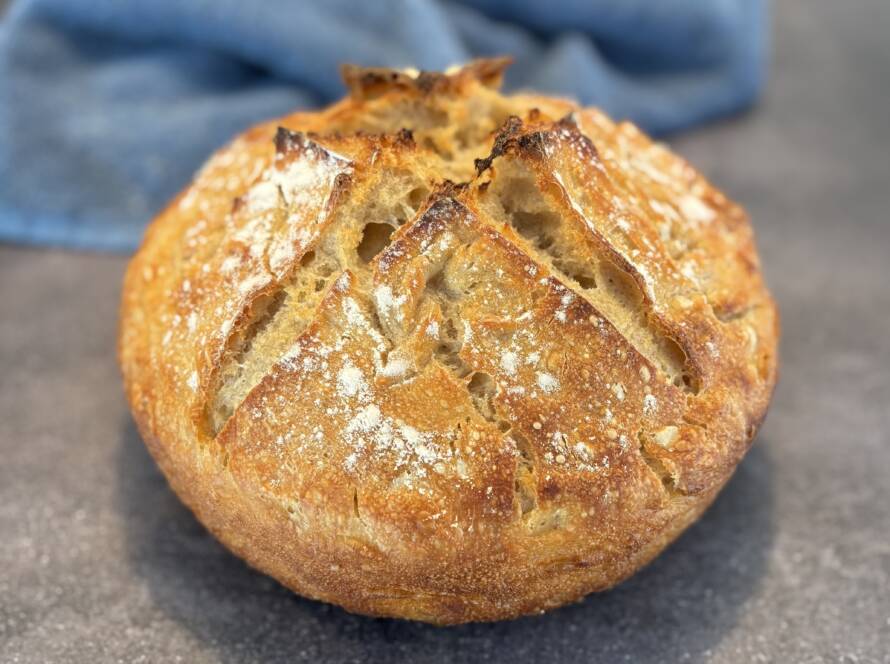
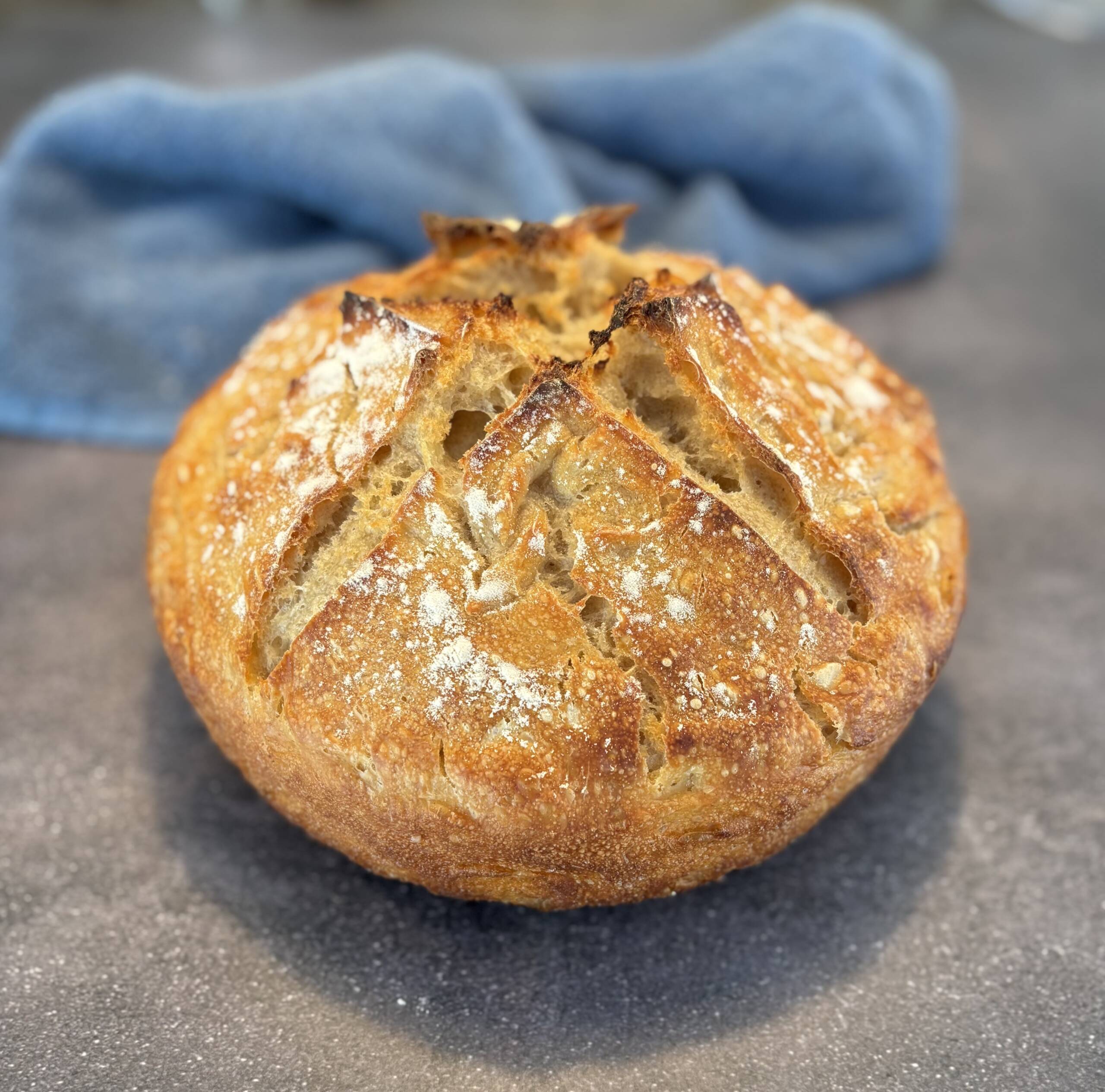
- Carefully remove the Dutch oven from the oven and baste the bottom and sides with ghee/clarified butter (heat stable). Transfer the dough carefully flip it into the Dutch oven so the top of the dough is facing up (be careful – it’s hot!!!), sprinkle with some flour and scour using a sharp blade by making one long slit from one side to the other slightly off-centre and then bake for 20 minutes with the lid on.
- Remove the lid, turn the temp down to 200C /390F degrees and bake for another 20 minutes, then carefully remove the Dutch oven, remove the bread and cool on a cooling rack.
- You can test if the bread is ready by knocking it with your knuckle. – it should make a hollow noise. You could also test the temperature by inserting a food thermometer – the inside temperature should reach 96-98C/205-208F when it’s done.
- Allow the bread to cool for a minimum of 15 minutes.
- Enjoy immediately or store in a cotton bag/ bread tin in a cool, dry place and use within 3-5 days.
- You should have some left-over starter in the jar. Re-feed this with 60g (2.1oz) organic wheat flour (12-14g protein/100g) and 60g (2.1oz) tepid filtered water and store it in the fridge until you want to bake your next bread (1 week optimally, 2 weeks max).
- If you are not ready to bake your bread yet after 2 weeks, you need to re-feed the starter by halving the mixture and re-feeding it with with 60g (2.1oz) organic wheat flour (12-14g protein/100g) and 60g (2.1oz) tepid filtered water. You may notice a dark liquid on the top of the starter, this is not an issue and it can be poured off before the re-feed. If you noticing mould, discard the starter and restart the process of beginning a starter.
Notes
Sourdough bread is a healthier option to traditional bread because the wild yeasts that are found naturally on the flour and lactobacillus bacteria help ferment the flour over a longer period, improving the bioavailability of nutrients such as calcium, iron, magnesium and zinc by reducing the anit-nutrient phytic acid.
The fermentation process reduces the glycaemic index, thereby slowing the glucose released into the bloodstream and thereby improving satiety and fullness. Although the bread still contains gluten, gluten-intolerant people may be able to tolerate sourdough bread due to the slow fermentation process, which helps break down some of the gluten ¹ ². Sourdough, however, is not advised for people suffering with Coeliac's disease. Spelt is considered and ancient grain which hasn't been crossed with other wheat types, which may make it more tolerable to some individuals who are wheat-sensitive. Spelt and wholewheat are high in B vitamins and the minerals magnesium and zinc, with 100g supplying 30% the daily required amount of these minerals, and contains healthy fibre and amino acids.
Combine white & wholewheat flour in a 50:50 ratio.
I've found that using a smaller Dutch oven (2.8 litre/ 95fl oz and 20cm / 7.8 in diameter) helps keep the shape of the bread and allows for a perfect rise every time. In addition, try to use a flour that is organic and contains at least 12-14g of protein.
¹ Ribet L, Dessalles R, Lesens C et al. Nutritional benefits of sourdoughs: A systematic review. Adv Nutr. 2023;14(1):22-29.
² Marín-Sanz M, Sánchez-León S, León E et al. Comparative characterization of the gluten and fructan contents of breads from industrial and artisan bakeries: a study of food products in the Spanish market. Food Nutr Res. 2022;66.
Approximate micronutrient info per 50g serving:
Vitamins
B1 (Thiamine) – 0.1mg (11%)
B2 (Riboflavin) – 0.1mg (5%)
B3 (Niacin) – 2.2mg (16%)
B5 (Pantothenic Acid) – 0.4mg (9%)
B6 (Pyridoxine) – 0.1mg (7%)
B12 (Cobalamin) – 0µg (0%)
Folate – 15.4µg (4%)
Vitamin A – 0.2µg (0%)
Vitamin C – 0.0mg (0%)
Vitamin D – 0IU (0%)
Vitamin E – 0.3mg (2%)
Vitamin K – 1.5µg (2%)
Minerals
Calcium – 12.8mg (1%)
Copper – 0.2mg (24%)
Iron – 1.9mg (11%)
Magnesium – 50.6mg (16%)
Manganese – 1.2mg (66%)
Phosphorus – 147.1mg (21%)
Potassium – 142.2mg (5%)
Selenium – 3.9µg (7%)
Sodium – 121.7mg (8%)
Zinc – 1.5mg (18%)
% RDI based on an adult female
Nutrition Information:
Yield: 16
Serving Size: 50g/ 1 medium slice
Amount Per Serving:
Calories: 144kcal/50gTotal Fat: 1.5gNet Carbohydrates: 26.0gFiber: 3.4gProtein: 5.3g